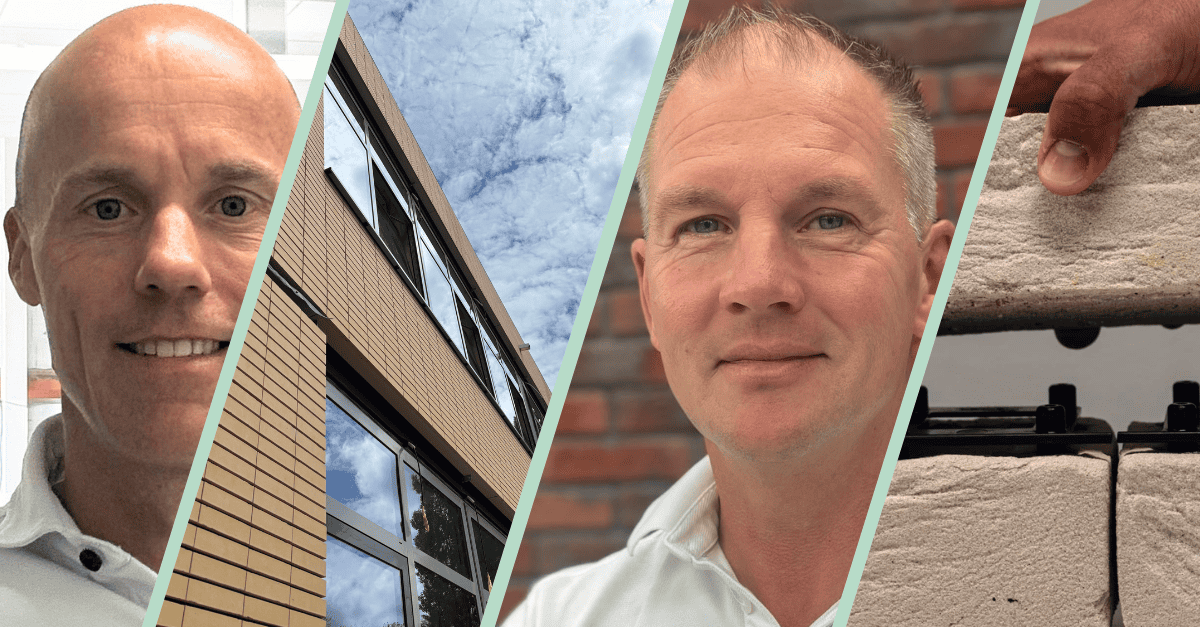
Founder Dennis Deen started as a bricklayer in construction after his time in the Marines. He gained several qualifications and became a manager at a building contractor. In 2006, he bought a scaffolding company. His company grew rapidly. Dennis: “At the peak, there were around a hundred to a hundred and twenty people working on-site. We worked extremely hard, but actually barely made any money.” The problems in the construction sector did not escape him: the structural shortage of bricklayers and the dependence on the weather to be able to lay bricks. “I saw that the real problem lies in the use of mortar. You need skilled tradespeople for that and good weather. What if you could build a facade without mortar? What if someone without years of training, but with a brief instruction, could stack bricks?”
From idea to first commission
The idea for a circular stacking system for bricks was born. This system consists of calibrated bricks and specially developed intermediate layers, or ‘layers’. By cutting extremely precise grooves into the bricks, façades can be built up layer by layer. As the bricks are not fixed together with mortar, they can be dismantled later and reused. This saves raw materials and makes the system highly sustainable and circular. Furthermore, the system is compatible with 80 to 90% of all bricks, giving architects considerable design freedom.
Dennis discovered that developing his concept took a lot of time. In 2016 and 2017 he sold his existing business to focus fully on the innovation. In 2018 drystack founded. A large order for some 750,000 bricks soon followed. “That was great, of course,” Dennis says. “But for us personally it was back-breaking work, as we were working 24 hours a day. However, this project did prove that our concept could work on a large scale.”
Fall down, get back up and start again
The development demanded much more than a good idea. Dennis: “We needed a mechanical engineer to optimise the production of the necessary bricks, we had to jump through countless hoops for certification and you have to convince builders of your story. That took a lot of money. And sometimes you make a major slip-up. For instance, we invested heavily in a machine builder who promised to solve a technical problem. Not a bit of it. Nine months later, we had to pull the plug. We lost a lot of money and had incurred a delay of a year and a half. But then again, you made a decision with the information you had at that time. You are allowed to be angry for a week, but after that you have to just get on with it.”
Not everyone needs to be your customer
For the next growth phase, Drystack got in touch with Birgitta Kramer from ROM InWest. The company was looking for financing for further scaling up and thus also came into the ATB programme Fair enough. That programme brought an important insight: a good product does not mean you have to try to convince everyone. “The first question in the ATB programme was: have you researched whether anyone actually needs your product? Then I realised we had been running around like headless chickens. During the programme, it became clear how important it is to know precisely who your customer is. Not the contractor who is only participating because it is a requirement in a tender, but the party that is intrinsically motivated to innovate.” Drystack is therefore focusing increasingly consciously on frontrunners. First serving one customer well, ensuring quality, and securing a repeat order. Dennis: “Grass doesn't grow any faster if you pull it. You have to go through all the phases.” Two years ago, Bas Peereboom joined Drystack as commercial director, after having worked at a corporate for seventeen years. He focuses on sales, marketing, and communication. Bas: “Construction is conventional and risk-averse. So we have to be reliable and guarantee quality to land major contracts. And once a market leader like Dura Vermeer starts using our concept, you know things will take off. Building long-term relationships and becoming a construction partner is crucial.”
Valuable collaboration
The collaboration with ROM InWest is meaningful for Drystack. The team can brainstorm with the experts involved, regarding sales and marketing for example, but also on the question of which market truly deserves priority. In addition, the network is valuable, Bas indicates. “For a small innovative company, it is difficult to get directly to the right people at large organisations and (semi-)public bodies.". ROM InWest can open doors which are themselves difficult to access for Drystack.”
Ready for the next step
Meanwhile, two major brick manufacturers have joined on board who will themselves invest in machinery to process bricks at their own locations. This prevents unnecessary transport and enables further scaling up without Drystack having to build a large production facility itself. In addition to circular construction, Drystack also solves a staffing problem. People can be trained as stackers within a few days. Construction companies therefore do not have to turn down large contracts due to a shortage of staff. To achieve this, Drystack collaborates with training organisation Bouwmensen, among others. Bas talks about an employee who first walked around the construction site with a broom, was trained for three days and then stacked a facade together with two colleagues. “That lad was as proud as punch. That is fantastic, of course.” It illustrates where Drystack wants to go: combining circular construction with less waste, less dependence on scarce craftsmanship and a scalable business.
Dennis doesn't have to think twice about what he has learned after nearly ten years of pioneering. “There's a solution for everything. Even if you don't see it at that moment, you will see it after half a year, or after a year. In the Marines I learned to set goals and achieve them with the knowledge you have yourself. That's also how I started Drystack, as a loner. Whereas there are plenty of sparring partners you can make use of when you start a business. Make use of them, for the right focus and the right network that helps to open the next door.”