
Last year we wrote that North Holland’s technology policy deserves to do justice to its potential. That was primarily a plea based on our work for the National Technology Strategy. At the time, there was still a lack of a shared and substantiated view of what this region really means in terms of strategic importance in the Dutch and European context.
That picture is now in place. TNO Vector carried out the research on behalf of the province of North Holland, the Amsterdam Metropolitan Area and the North Sea Canal Area Program Office. The report links European developments regarding competitiveness and strategic autonomy with the Dutch industrial and technological policy and an in-depth analysis of the North Holland economy. What does this analysis mean for North Holland?
An inverse reasoning
Regional economic studies often start with what a region already has, identify the strongest sectors within it, and then label them as strategic. The study by TNO works from the outside in. The analysis starts with European and national policy priorities, including the Draghi report, the Competitiveness Compass, and the National Technology Strategy. TNO then distills 27 potentially strategic economic activities from these. Only then does the question arise: what position does North Holland hold in this regard? This approach prevents us from relying too much on what is already present in the region. Instead, the question focuses on what contribution North Holland makes to larger Dutch and European challenges.
Social interest and systemic position
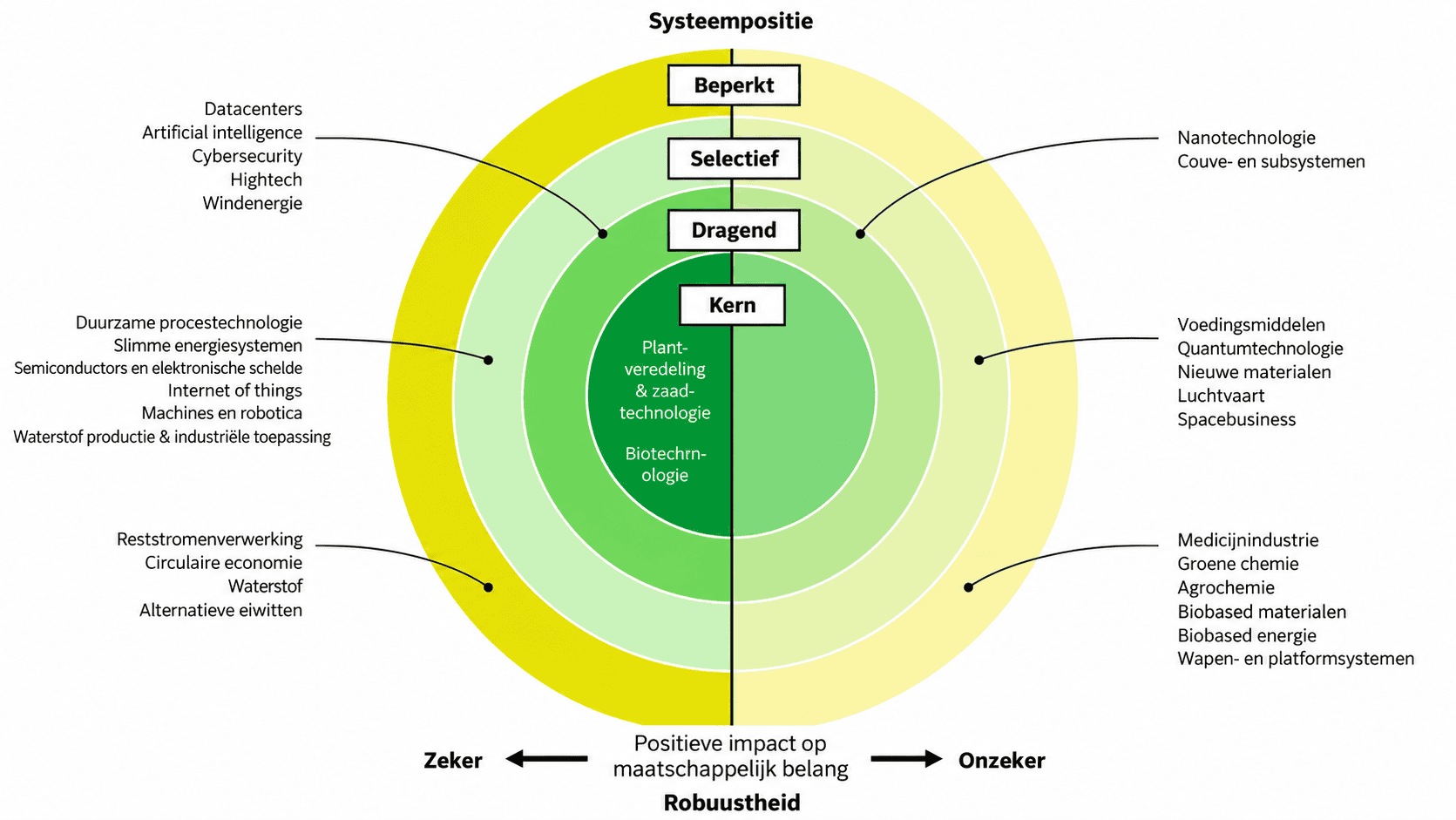
TNO looks at two aspects in this context. First, the societal interest: the contribution to future earning potential, safety and resilience, sustainability and circularity, and health and well-being. This also takes into account how certain or ‘robust’ that contribution is. Therefore, TNO distinguishes between technologies that have already proven themselves and technologies whose promise still needs to be demonstrated. Second, TNO looks at the system position of North Holland: how strong is the region’s specialization, how complex and difficult to imitate the existing knowledge is, and what position does North Holland take within broader value chains and knowledge networks? We find that last nuance valuable. Strategic importance does not necessarily mean that you have to be able to do everything yourself. A region can actually be strategically important because it forms an indispensable link in a larger system.
The dart board, ring for ring
Source: Strategic economic interests of the province of North Holland – TNO Vector
In the core There are two activities in which both the societal interest and the regional position of North Holland are strong: biotechnology and seed breeding. In biotechnology, a high level of knowledge complexity, a strong knowledge base, and the highest patent score of all the activities surveyed come together. In seed breeding, North Holland even has a distinctive concentration at the global level with Seed Valley.
The second ring consists of systemic driving activities: data centers, artificial intelligence, cybersecurity, medical technology and wind energy. They enable the functioning and innovation of other sectors through infrastructure, digital systems or supporting knowledge. Nanotechnology and cocoa and sugar products are also included in this category, although their societal contribution is less certain according to TNO.
The third ring: selective. This is the most differentiated group and therefore the most interesting one. Here the region does not have a strong position across the full spectrum of an activity, but rather in specific links. Aviation derives its position primarily from concentration and specialization around Schiphol, while the knowledge base is relatively limited. Internet of Things scores differently, with high complexity and a strong regional knowledge base but limited scale. Sustainable process technology, maritime industry, sensor and measurement and detection technology, smart energy systems, quantum technology and new materials derive their significance primarily from complementarity within broader chains. The food industry and steel industry are also in this group, with more uncertainty regarding the societal contribution.
The outer ring Includes activities in which North Holland does not have a pronounced distinctive system position and that have a highly variable societal relevance. These include, for example, circular construction, waste stream processing, alternative proteins, and the broader hydrogen chain. These activities can be highly relevant to society, and the region needs them to solve problems in its own area. At the same time, the region itself has less influence on their development. The same applies within sectors: partial activities can be more strategically relevant than the sector as a whole. Looking only at sectors does not reveal where the real strategic strength lies.
Our main conclusions
A first important conclusion is that the report shows that strong knowledge position and actual earning potential are two different things. North Holland scores high on patents, publications and knowledge institutions. Amsterdam, for example, is strong in medical biotechnology. But developing knowledge is something different from monetizing that knowledge and successfully bringing it to the market. It is precisely in that valorization, scaling up and financing that we often see things go wrong in our practice. Furthermore, the control over companies in some strong regional activities (big companies) is partly in foreign ownership. Decisions about these activities are then made abroad.
At least as relevant is the conclusion of TNO that economic policy should not only be organized along sectoral lines, but from the role that activities play in a system. Core positions require protection and reinforcement. System-driving activities require, above all, good preconditions. Selective positions require targeted choices for the niches in which North Holland is truly distinctive. We consider this conclusion about policy design to be the most useful from the entire report.
Here lies the real work: from analysis to implementation
TNO rightly calls this snapshot a moment in time, and that is methodically correct. But in practice, such positions do not change overnight. Seed Valley, the campus surrounding Amsterdam UMC, and strong knowledge clusters have been built over decades. That means that we can build on the outlined foundation on a multi-year basis, but new strategic positions also do not emerge within one administrative period. This calls for patience and consistency, two qualities that are difficult to reconcile with policy cycles. This is, in our view, the biggest challenge. TNO does not deliberately provide a ranking or automatic prioritization. The report explicitly makes its choices and then presents them to the parties where they belong. But even when those choices have been made, there is still no perspective for action. Analysis and policy only become valuable when they are translated into programs, instruments, funding, and people who can find each other. That translation into action is the actual work, and that takes years.
ROM InWest takes on its role
At ROM InWest, our field is exactly in line with this transition. In the coming time, we will further develop the most important strategic positions towards our new multi-year plan and together with our partners in the region. We will continue to invest in companies within these priorities and explore how we can further increase our efforts in, among other things, biotechnology. At the same time, we are deepening the prioritized domains separately. Each domain requires its own ecosystem analysis: previously, we did that for medical biotechnology and earlier this year for medtech. Other domains are following. A year ago, we observed that North Holland has gold in its hands, but is still digging for it sparingly. Now, an excellent map of where that gold is located is available. We still have to do the work ourselves: explore, make choices, collaborate, and develop.
Read the entire TNO report yourself? Strategic economic interests of the province of North Holland