
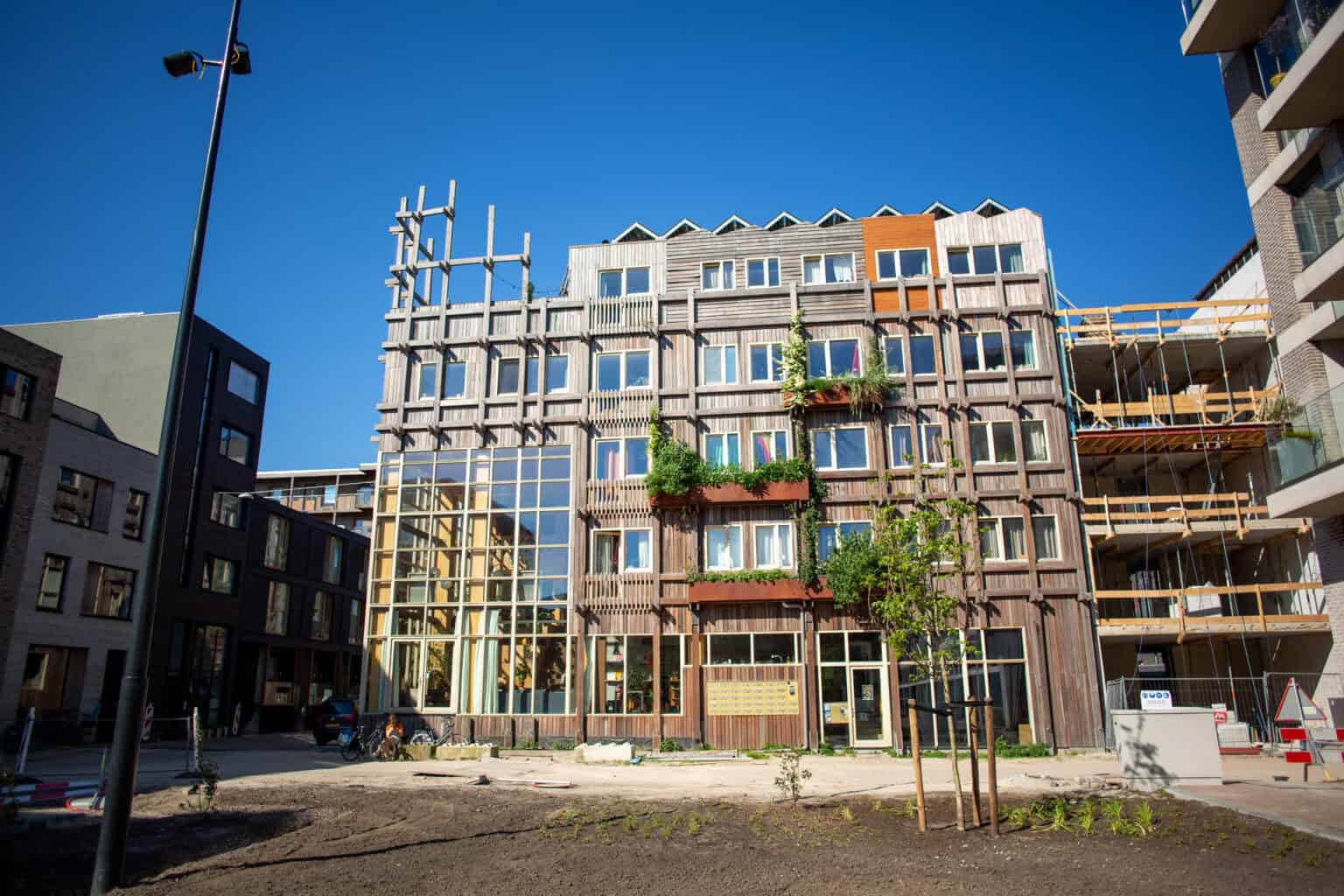
Residents become developers themselves
The Warren was born from an equally simple as ambitious idea: rather than waiting for a developer to build homes for them, the future residents become the project developer, developer and ultimately the manager themselves. They put their word into action and The Warren became Amsterdam’s first completed self-build housing cooperative. The residents jointly developed 36 social and middle-rent housing units on Centrumeiland in IJburg. These units are divided into 5 living groups: small studios, starter homes and family homes. A whopping 30 percent of the area is made up of communal spaces. Think of an office space, a children’s room, a craft room, a music studio and a meditation room. This makes The Warren a real community. In terms of sustainability, The Warren also set the bar high. For example, they chose a wooden hybrid load-bearing structure, recycled materials, a green façade and a system for collecting and reusing rainwater. With nearly 200 solar panels and its own heating and cooling system, the building was also designed to be energy-positive.
An innovative concept requires financiers who dare to take risks
Sustainable, social and developed by the residents themselves. This innovative nature made funding in the early stages complicated. Danny Groenewegen, treasurer of De Warren: “Dutch banks were hardly familiar with this type of housing cooperative and were reluctant. In addition, we had to go against established practice because such a structure does not always fit within existing regulations. In Germany, our concept is well known and therefore we found the German sustainable GLS Bank willing to finance a large part. That was a positive signal to other financiers.” Therefore, De Warren brought together various funding sources, including the loan from GLS Bank, subsidies and bond loans from future residents and other stakeholders. “The funding from PDENH completed the puzzle,” says Danny.
The choice of PDENH
Since 2024 it has been managed ROM InWest the PDENH fund for the province of North Holland. Until then, the fund was managed by StartGreen Capital and KplusV. Rik Hogendoorn of KplusV was involved in De Warren for more than three and a half years as an investment manager from PDENH. Rik: “When launching new concepts, financing from traditional banks isn’t always easy. PDENH It exists to support innovative, disruptive initiatives that struggle to secure full funding from the private market. At De Warren, the project’s sustainable nature appealed to them. The fact that De Warren had received a loan from a major German bank created additional confidence. The combination of innovation, sustainability, and social impact made De Warren interesting. ”This is one of the first housing cooperatives to have built a real estate project in this way themselves. I find it incredibly exciting that we were able to contribute to that from the very beginning through PDENH.“
From pioneering to successful financing
The financial model of De Warren also appears to be working well. “The beauty of real estate is that it always generates income. Especially in Amsterdam, where the demand for housing is high,” says Rik. “Because there are few tenant turnover, the building has so far been fully rented out every time. This provides a constant inflow of income.” Danny adds: “The business case we had made in advance – taking into account maintenance, ground rent, taxes, interest and repayments – was good. It is a stable project that is financially sound.” The cooperative always met its payment obligations throughout the term and even repaid the debt faster than necessary. In addition to the regular payments, an additional amount was paid annually, and by now the financing of PDENH has been fully repaid. Rik: “This shows how public funding can help enable innovations that the regular market is still reluctant to undertake at an early stage.”
The Warren as a good example
Now the residents of De Warren are sharing their knowledge about, among other things, setting up a housing cooperative, financing, sustainable construction, and developing projects together with like-minded people who want to set up a similar initiative. Danny: “When building a project, you always have to take into account things that go differently. For example, we wanted to share the generated solar energy in combination with a collective energy connection. After all, a large part of the electricity consumption takes place in the common areas. But the electricity provider ultimately decided that each home should have its own connection. So we had to adjust that during construction. Things like this are something others can learn from. So far, there are already two new self-build housing cooperatives in our neighborhood that are practically complete.”
A good signal to the market
The Warren It proves that the concept works and that makes the way easier for others, also in the area of financing. Rik sees that happening as well; Dutch banks are now more open to this type of housing cooperatives. “The Warren shows that these types of projects are indeed financially feasible. That is a good signal to the market. And The Warren shows that residents themselves can develop complex projects when entrepreneurship, knowledge, collaboration and appropriate financing come together. So you don’t always need a large real estate developer to realize something like this.”
The power of partners in the early stages
At ROM InWest, we are proud of this innovative financing. Innovation often starts with parties who dare to do something different than usual. However, they need partners who are willing to move with them in that initial, early phase and support them with advice and financing. ROM InWest can help with that. If you would like to know more about this, feel free to contact Reynier de Monchy.