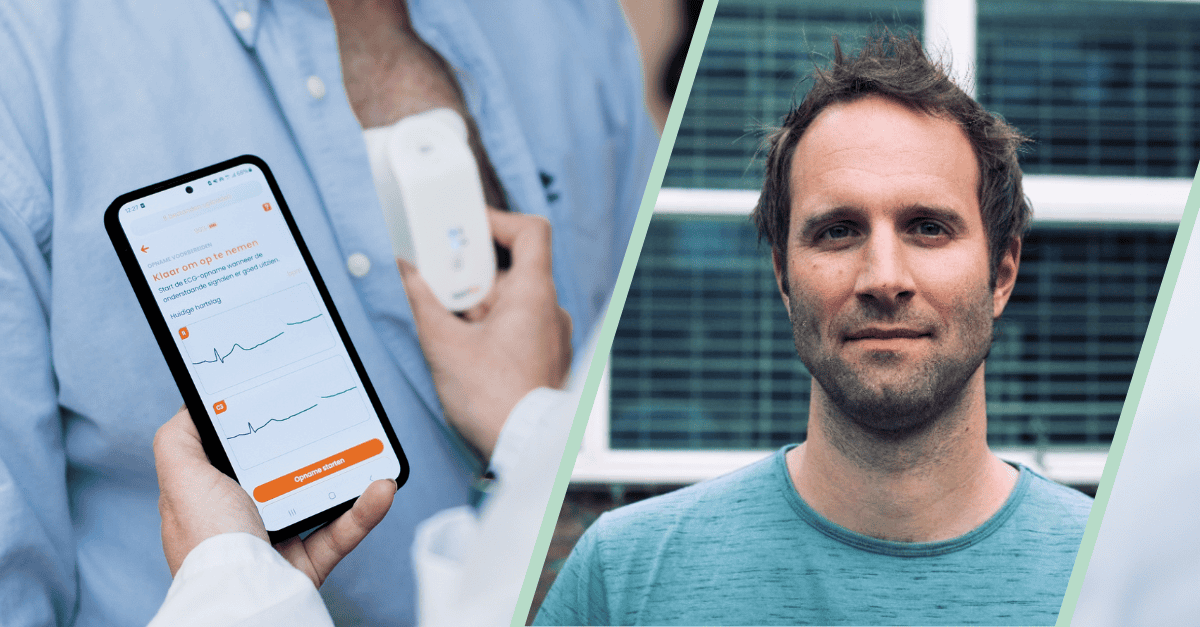
Tjebbe Tauber is the passionate CEO of HeartEye. Four years ago, he switched from banking to HeartEye to contribute to better healthcare in the Netherlands. Tjebbe: “The early detection of heart problems is enormously important. Someone dies from cardiovascular diseases every quarter of an hour. Many of these people have never seen a cardiologist. Some of this mortality could have been prevented if those people had been seen by a cardiologist in time. On the other hand, many people are unnecessarily referred to hospital. 65% of people who see a cardiologist are referred back to their GP after the first visit. As HeartEye, we want to solve both of these problems with early, high-quality cardiac diagnostics that take place outside of hospital. Very accessible, simply at the GP's surgery or even at the patient's home.”
Clarity within one minute
Taking heart films (ECGs) now mainly takes place in hospitals or with GPs. It takes 5 to 15 minutes, says Tjebbe: “The patient has to undress and in some cases shave, ECG stickers have to be applied to the chest, then the film is made and then the stickers have to be removed. With our innovative, handheld ECG recorder, a GP, physician's assistant or patient can make a 12-channel ECG within one minute. Without stickers, cords or complex equipment. Via a digital platform, the heart clip is shared with a doctor or specialist, who can then assist in interpreting the heart clip and assess whether referral to the cardiologist is necessary. Suppose a patient comes to his GP with chest pain. In an emergency, the GP always calls 112. But it is not always clear whether the symptoms are caused by the heart. Maybe it is just muscle pain from gardening that this person did the day before. With our ECG recorder, a cardiac ultrasound is taken within a minute that allows GPs to either quickly reassure their patient or refer them appropriately.”
Not everything at once
Tjebbe sees many possibilities for the ECG recorder. To sharpen the focus, he started via ROM InWest with the GO!-NH Market Readiness Programme. Here, entrepreneurs learn to bring their innovation to market in a short space of time. Under the guidance of experts, they work on validating their product, customer segments, and revenue model. Tjebbe: “In that programme, you focus on the stage your company is at. We don't have medical certification yet, so we have to prove our product-market fit without being allowed to sell our product for healthcare provision. We have created a clear profile of the ideal customer. For this, I conducted many interviews with healthcare professionals, and we decided on GPs. As soon as we have CE marking, we will start the early access programme with this group.”
A good story
“To GPs, we have a good story to tell. With HeartEye, GPs are maximally facilitated to provide ECG care to patients: it hardly takes any time to make an ECG anymore, it doesn't cause any hassle ordering stickers or training your staff, and remote cardiologist support is available. Most importantly, it allows GPs to help their patients immediately, without asking a lot from this already over-demanding group. Finally, there is a good business model for GPs. On the one hand, they can declare ECGs; on the other, a patient does not have to be referred to the cardiologist as often, which saves society a lot of healthcare costs. After all, hospital care is many times more expensive than GP care. We are now putting together a group of innovative GPs who would like to be the first to use our product. The aim is that 80% of these GPs will soon say: we are so enthusiastic about this way of working, we will continue to use the HeartEye ECG recorder. If we achieve that, we will have a clear product-market-fit. Only then will we focus on scaling up and growth within other target groups, such as ambulance personnel or supervisors of people with severe intellectual disabilities, or go international.”
Euros
Tjebbe decides: “The reality of healthcare is that money continues to play an important role. The great irony for me personally is that I left the bank to focus on better patient care and then I'm still thinking a lot about euros. Either for HeartEye self, the the investments required to bring this product to market, or because I'm working on business models for healthcare providers that support innovation. But I know what I'm doing it for: reducing mortality from heart issues by improving diagnostics and keeping care efficient, affordable, and accessible.”