
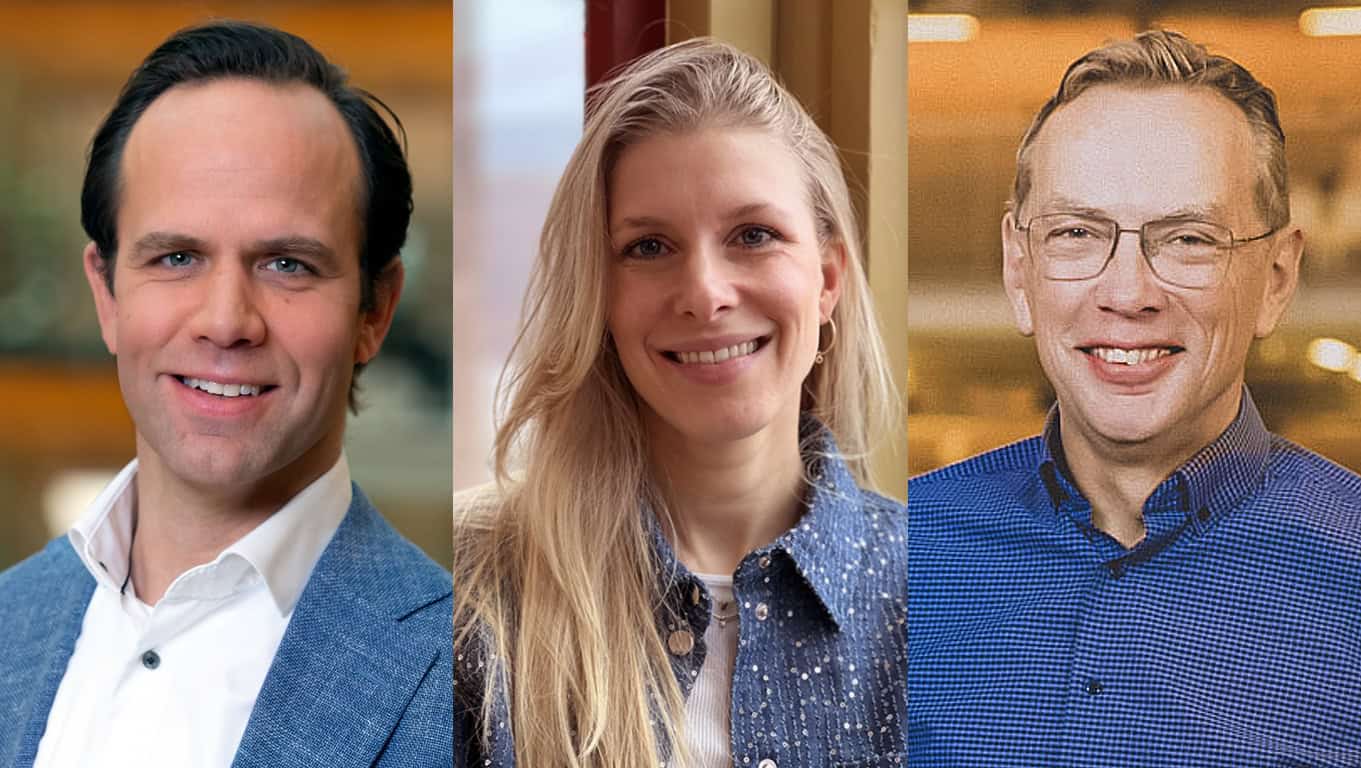
Three funds, three managers and three important questions.
An interview with Vincent Vierhout (MKB Fonds), Isabel van Nesselrooij (Transitiefonds) and Leendert van Waart (PDENH) on the ins and outs of an investment fund.
Vincent, Isabel and Leendert manage funds that are in different phases. SME Fund and Transition Fund started in 2022 and are building up their portfolio. PDENH has been around since 2013 and has been a closed-end fund since 2023-Lendert is now looking at the right moments to exit companies.
Vincent Vierhout, fund manager at Rom InWest since xxxx: “We are looking for companies that offer solutions in healthcare, education, housing or sustainability. We may also start supporting dual-use technology-usable for both civilian and military purposes.”
The fund's strength is demonstrated by the progress of companies we invest in:
The fund's strength is demonstrated by the progress of companies we invest in:
“Investing in innovation is inherently risky. That deters traditional investors quite a bit. But innovation is important for us as a society. That is why, as ROMs, we invest with fund capital from municipalities, the province and the state in promising innovative companies at times when the market is still on the sidelines.
The funds are revolving, though. With our shareholders” fund assets, we make financial returns over time, so we can redeploy the proceeds."
“We step in at the moment when there are many uncertainties. By stepping in early, we are supporting transitions that can start helping the economy in North Holland. But it is not a subsidy. Over time, there must indeed be a return.”
“That risk assessment revolves around the question: will end users embrace the innovation later? You are betting on a change in consumer behaviour-something that is often uncertain. In a circular economy, for example, you want to keep reusing materials, but that's not how our society is set up yet.
Or consider the healthcare sector. There, there is a staff shortage and growing demand for care. Then, investing in medical innovation might seem less risky, but you still have to be able to convince the doctor that your machine or method will soon offer the best solution. The market often doesn't dare to do that yet. We do. But indeed not just like that.”
Says Vincent.
Leendert: “Investing in innovation is inherently risky. That deters traditional investors quite a bit. But innovation is important for us as a society. That is why, as ROMs, we invest with fund capital from municipalities, the province and the state in promising innovative companies at times when the market is still on the sidelines.
The funds are revolving, though. With our shareholders” fund assets, we make financial returns over time, so we can redeploy the proceeds."
Isabel adds: “We step in at the time when there are many uncertainties. By stepping in early, we are supporting transitions that can start to help the economy in North Holland. But it is not a subsidy. Over time, there must indeed be a return.”
Vincent: “That risk assessment revolves around the question: will end users embrace the innovation later? You are betting on a change in consumer behaviour-something that is often uncertain. In a circular economy, for example, you want to keep reusing materials, but that's not how our society is set up yet.
Or consider the healthcare sector. There, there is a staff shortage and growing demand for care. Then, investing in medical innovation might seem less risky, but you still have to be able to convince the doctor that your machine or method will soon offer the best solution. The market often doesn't dare to do that yet. We do. But indeed not just like that.”
Isabel: “For the Transition Fund and the SME Fund, the focus now is on building a healthy portfolio. We are only four years old, right? So we are still working on new investments. Talking to a lot of entrepreneurs, scouting, figuring things out. We expect the first positive exits in a few years at the earliest.”
Vincent: “For the SME Fund, the goal is to be fully invested around 2029. That means three to four more investments. By then, we expect to have a portfolio of around 20 active companies, after which most of the fund's assets will have been deployed. In addition, we will continue to invest incrementally in companies in our portfolio that are developing positively.”
Isabel: “And remember: the Transition Fund has a larger fund capital and longer lead time than the SME Fund. By 2030, we want to have a portfolio of 20 to 25 companies and projects. And the term for growth with us is five years longer than with the SME Fund. The Transition Fund also provides project financing, for example for the construction of a sustainable factory. Such loans have a (much) longer maturity.”
Leendert: “The PDENH fund is at a different stage, as mentioned. We are finalising the portfolio. With each new round of funding, we look at whether that is the right time to exit. It is then about timing, and finding the right market player to take over our role.”
Leendert: “At every exit, we do an analysis of what went right and what went wrong. This shows every time that, surprise surprise, good management is crucial. We are therefore extra critical of management in all our investments.”
“The moment of exit is part of the conversation from the beginning. After all, predictability is important for mutual trust. When we exit as investors, we also dilute as shareholders. In the world of venture capital, this is sometimes seen as taking a loss. For us, on the contrary, it means that our job is done. It shows that there are market players ready to take over our role as investor.”
Isabel: “As with PDENH, we discuss what a possible exit looks like from the moment we get in. Transparency prevents surprises. The entrepreneurs know where they stand and so do we.”
Vincent: “We are critical when a company does not make the progress it predicted beforehand and is not willing to apply sufficient self-reflection to it. Furthermore, we only want to invest in companies that effectively support social transitions. That means making hard choices sometimes. But when we stop companies that don't show enough progress, it frees up capital for other promising investments. “That is the power of a revolving fund.”
Isabel: “Right now, we are focusing more on investing in projects and in sustainable food systems to achieve a balanced spread. That was later added to our strategy as part of the broader transition task.”
Leendert: “Ultimately, at every exit, we make sure we get a fair price back for our investment. That money goes back into the fund and is redeployed. That way, the fund remains revolving and we can support generation after generation of innovative entrepreneurs.”